The crisp, metallic snap of a fresh sheet of washi hitting your work surface is the ultimate reset button for a cluttered brain. There is a specific, visceral magic in how Origami Folding Sequences transform a two dimensional plane into a structural masterpiece through nothing but calculated tension and geometric logic. When you run your thumb along a fiber, you are not just making a crease; you are breaking the lignin bonds in the paper to create a permanent memory.
This is not just about paper birds. This is about the physics of the fold. As you engage with these nine sequences, your heart rate actually syncs with the repetitive motion of the valley fold and the mountain fold. The paper resists you at first, boasting a high tensile strength that demands respect. But as you apply heat from your fingertips and the focused pressure of a tool, the material yields. It is a silent conversation between your tactile senses and the mathematical precision of the square. Grab your favorite tea and clear your desk; we are about to turn physics into peace.
THE STUDIO KIT

To master these sequences, you need more than just paper. You need a kit that respects the structural integrity of your medium. Professional folders rely on a bone folder, a polished tool made of bovine bone or Teflon that allows you to burnish a crease without tearing the delicate surface fibers. You will also want a metal ruler for measuring exact centers and a self-healing cutting mat to provide a consistent, non-slip friction coefficient for your base.
The paper itself is your primary technology. Look for Kami, which has a specific ply that holds a sharp crease, or Tant, which is dyed through the pulp and offers a beautiful, slightly porous texture that catches the light. For Material Substitutions, if you cannot find specialized paper, high quality parchment or even heavy gauge kraft paper can work. Avoid standard printer paper; its short fiber length makes it prone to cracking under the stress of complex squash folds.
THE TEMPO
The "Maker's Rhythm" is a state of flow where the time between folds becomes a metric of mindfulness. For these nine sequences, expect to spend roughly ten minutes on the foundational geometry and twenty minutes on the intricate collapsing phases.
- The Prep (5 mins): Calibrating your square. Even a millimeter of deviation in the initial cut will compound into a structural failure by step seven.
- The Pre-Creasing (10 mins): This is the most meditative phase. You are "mapping" the paper, creating the skeletal structure that the final form will follow.
- The Assembly (15 mins): The high energy phase where the 2D sheet jumps into 3D space.
THE CORE METHOD
1. The Blintz Foundation
Start by folding all four corners to the center point. This creates a dual layer of paper that increases the compressive strength of the center.
Mastery Tip: This step relies on geometric centering. By doubling the thickness at the core, you create a structural hub that prevents the paper from warping during later, more aggressive manipulations.
2. The Bird Base Pivot
This sequence involves a series of petal folds that stretch the paper's grain. It is the most iconic of all Origami Folding Sequences.
Mastery Tip: Watch the grain direction. Paper fibers usually run in one direction; folding against the grain requires more pressure to ensure the crease stays "locked" in place.
3. The Waterbomb Collapse
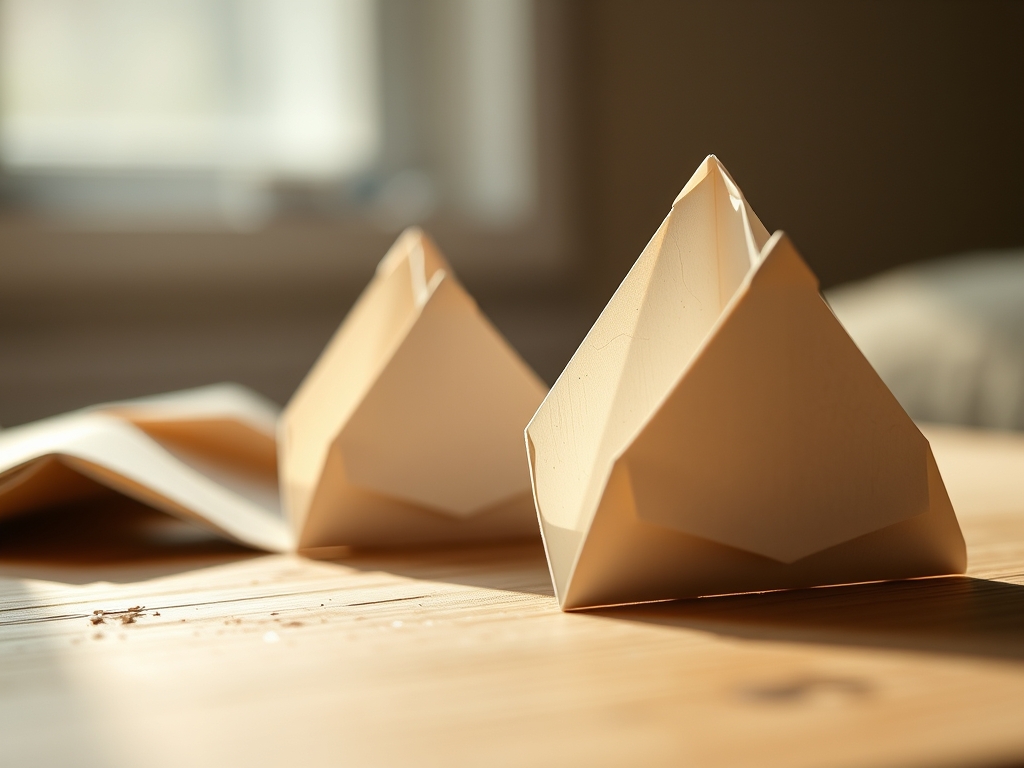
By creating a series of diagonal and orthogonal creases, you allow the paper to collapse into a multilayered triangle.
Mastery Tip: This utilizes mechanical advantage. The stored energy in the pre-creased folds acts like a spring, guiding the paper into its new form with minimal manual force.
4. The Squash Fold Alignment
Open a pocket of paper and press it flat to create a symmetrical diamond. This is where your bone folder becomes essential for a sharp finish.
Mastery Tip: This step tests the torsional rigidity of the paper. If your creases are not perfectly aligned, the "squash" will result in an asymmetrical bulge that ruins the final aesthetic.
5. The Inside Reverse Fold
Tuck a corner inside the body of the model to change the direction of a point. It is a masterclass in spatial reasoning.
Mastery Tip: This fold relies on friction locking. The internal layers hold the fold in place without the need for adhesive, utilizing the natural "grip" of the paper's surface texture.
6. The Rabbit Ear Pinch
Fold two adjacent edges to a center line and allow the excess paper to stand up like a small flap.
Mastery Tip: This creates a stress concentration point. Be careful not to over-burnish the tip, or you risk shearing the fibers and causing a "blowout" in the paper.
7. The Crimp Fold Transition
Create two parallel folds in opposite directions to "step" the paper down. This adds complex texture and depth.
Mastery Tip: This sequence mimics corrugation physics. By adding these steps, you significantly increase the model's resistance to bending along that axis.
8. The Sink Fold Challenge
Push the top of a point down into the body of the model. This is the ultimate test of patience and precision.
Mastery Tip: This requires managing volumetric displacement. You are forcing the paper to occupy a smaller internal space, which increases the internal tension of the model.
9. The Final Burnish
The last sequence involves refining every edge and "opening" the model to its final 3D state.
Mastery Tip: Use your fingertip oils sparingly. While a little moisture helps the paper become more malleable, too much will degrade the lignin and make the model soft and prone to sagging over time.
THE TECHNICAL LEDGER
Maintenance & Longevity
To keep your origami crisp, store it in a low humidity environment. High moisture levels will cause the fibers to relax, leading to "fold creep" where the sharp edges begin to round out. A light spray of archival fixative can help seal the porous surface.
Material Variations
- Sustainable: Use recycled hemp paper; it has incredibly long fibers that allow for hundreds of folds without tearing.
- Premium: Try Washi infused with silk fibers for a textile-like feel and extreme tensile strength.
The Correction
- The Tear: If a corner splits, use a tiny amount of methyl cellulose (archival glue) to bridge the fibers.
- The Misalignment: If your points don't meet, use a caliper to find the error in your initial square and trim the base slightly to compensate.
- The Soft Crease: If a fold won't stay down, re-burnish it using a heated metal tool to "set" the paper's memory.
Studio Organization
Store your finished pieces in a rigid, acid free box. Use acid free tissue paper between models to prevent "burn-in" where the pigments from one paper transfer to another over time.
THE FINAL REVEAL
Look at that! You have successfully navigated the complex world of Origami Folding Sequences and come out the other side with a masterpiece of paper engineering. The way the light hits those sharp, burnished edges is pure dopamine. You have taken a simple, flat object and, through the power of geometry and your own two hands, given it a soul. Your mind is quiet, your creases are sharp, and your studio is officially a place of high level making.
STUDIO QUESTIONS
Why does my paper keep cracking at the corners?
Cracking usually happens because the paper has short fibers or is too dry. Try using a paper with a higher long fiber content, like mulberry paper, or lightly "breath" on the fold to add a tiny amount of moisture.
What is the best tool for sharp creases?
A genuine bone folder is the gold standard. Unlike plastic, bone is dense and smooth, allowing you to apply significant pressure to burnish the paper without leaving shiny marks or snagging the delicate surface fibers.
How do I fix a fold that is off by a millimeter?
If the error is caught early, you can "massage" the paper back into place. Use your thumbnail to gently push the fiber memory in the correct direction before applying a heavy burnish to lock in the new line.
Can I use any square paper for these sequences?
Technically yes, but for complex Origami Folding Sequences, you need paper with a high tensile strength and low gsm (grams per square meter). Thicker paper will become too bulky to fold after four or five layers.